
Journal Guides Comme des Garçons
Comme des Garçons: how to read the year on the label
Most Comme des Garçons pieces carry a year and a short code on the care label. Together they give the line, the season and the kind of garment.

Comme des Garçons does something few fashion houses do: it prints the year on the label. Find the white care label inside a piece and you will usually see the letters AD followed by four digits. Beside it sits a short product code. Read together, the two give you the line, the season and the kind of garment, before you have looked at a single runway photo.
Where to look
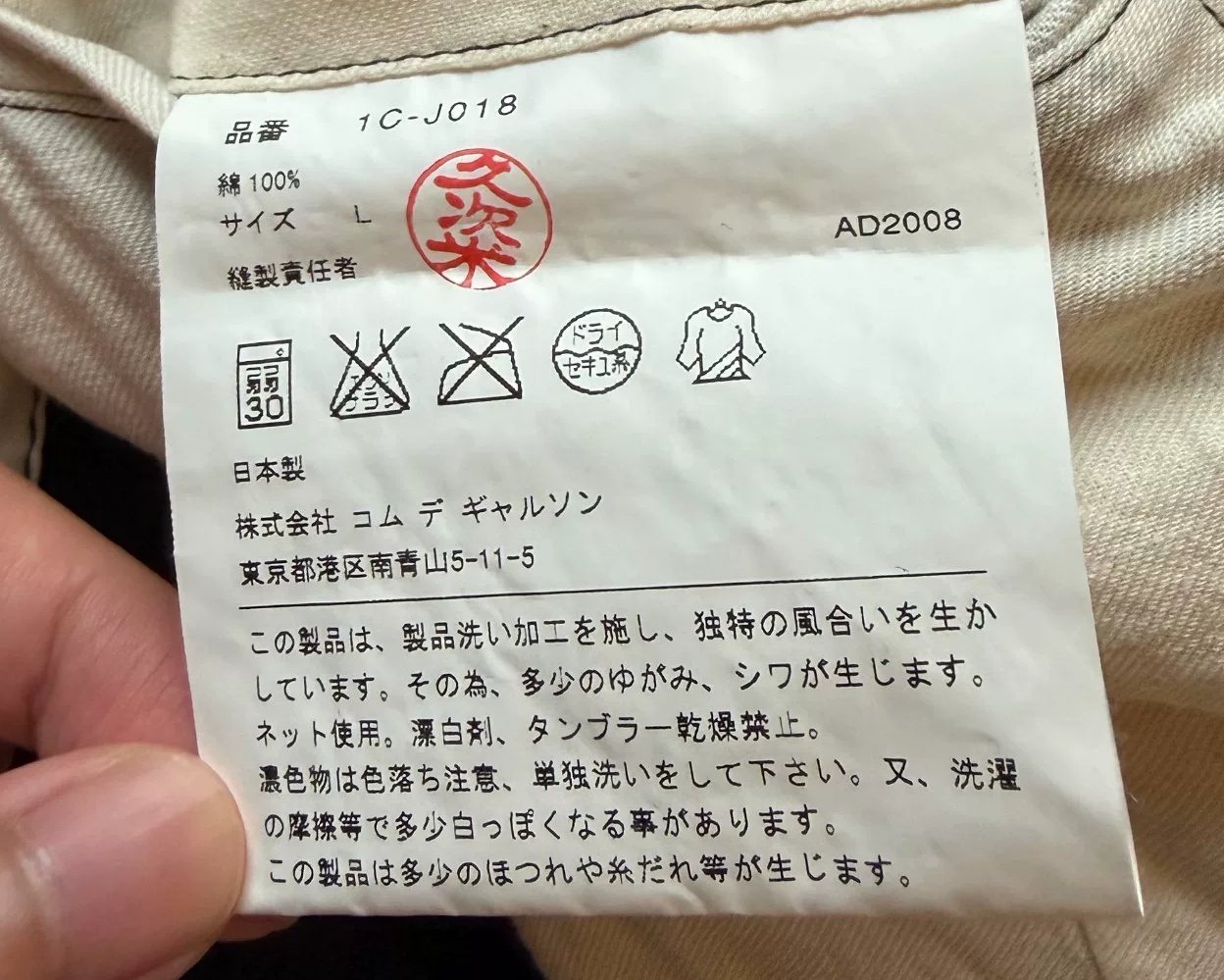
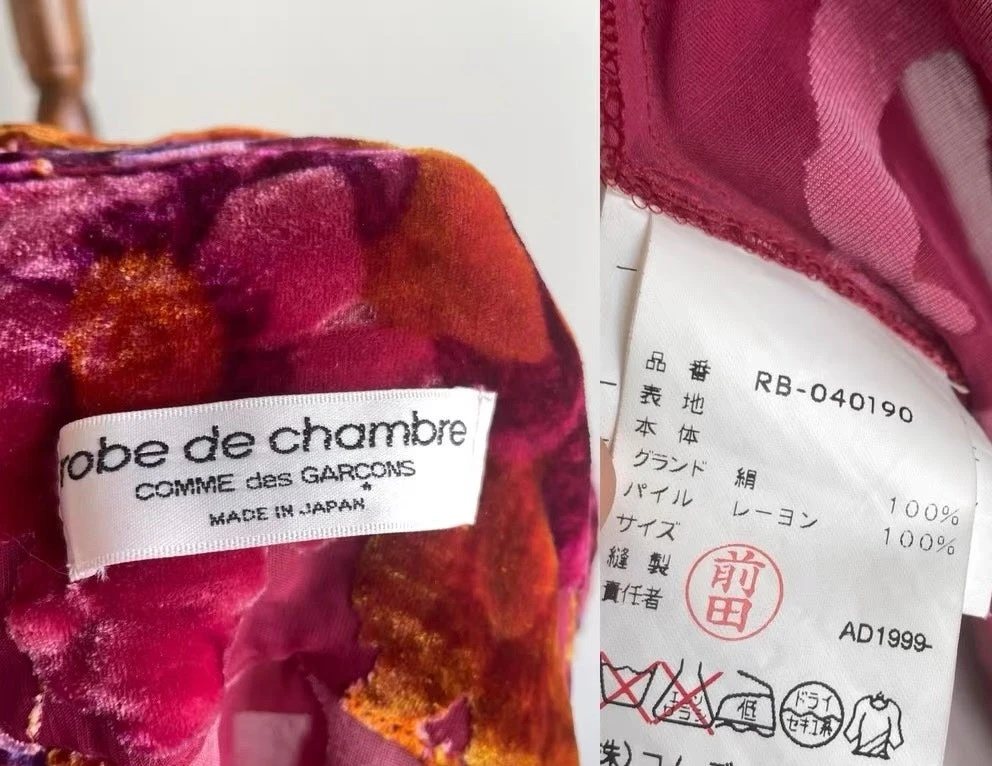
The care label is a white tag, usually sewn into a side seam or under the brand label. One side is in Japanese. The product code is at the top, next to the characters 品番. Below it come the fabric, the size and a red name stamp beside 縫製責任者, the person responsible for the sewing. The AD year is printed on the right.
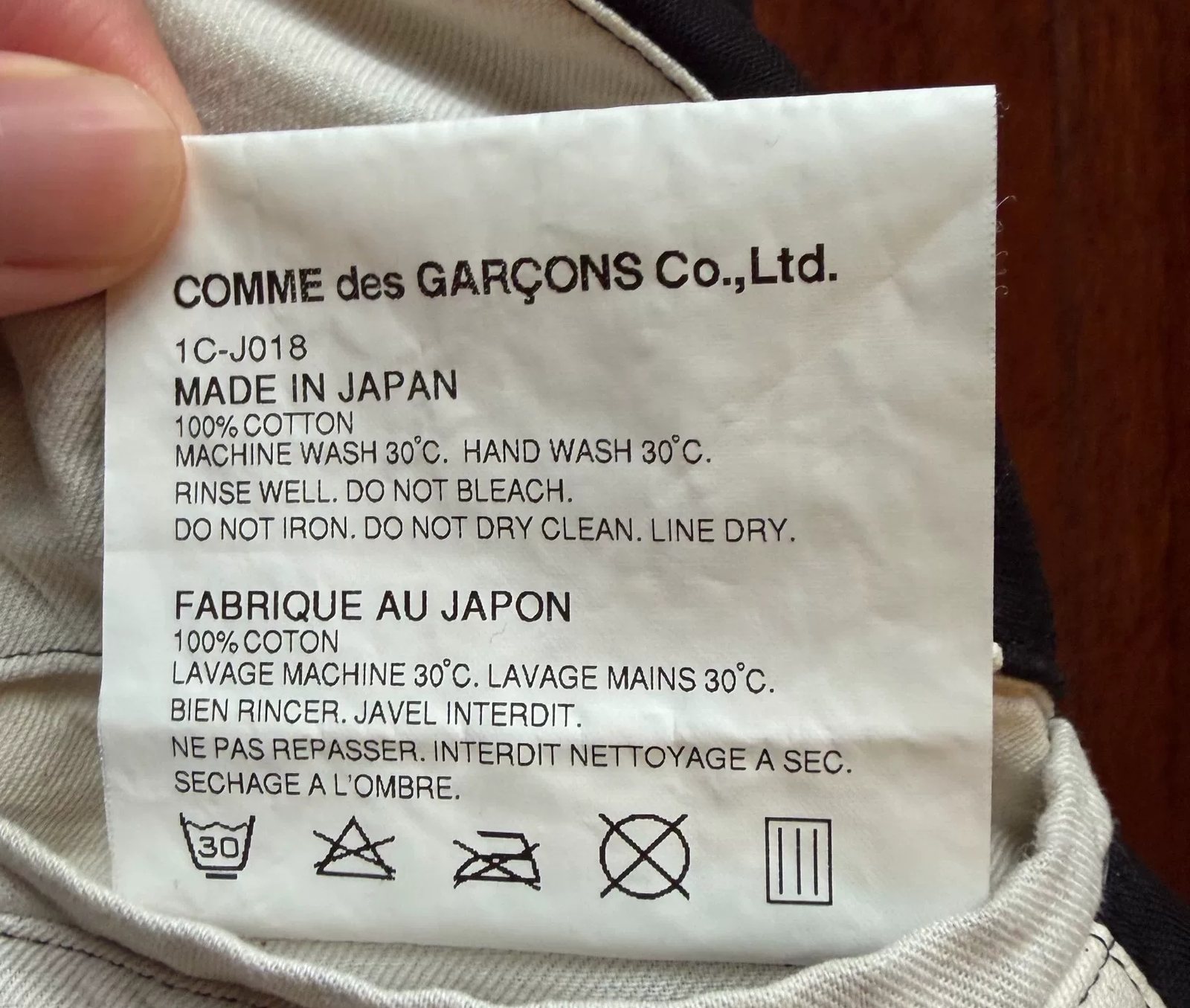
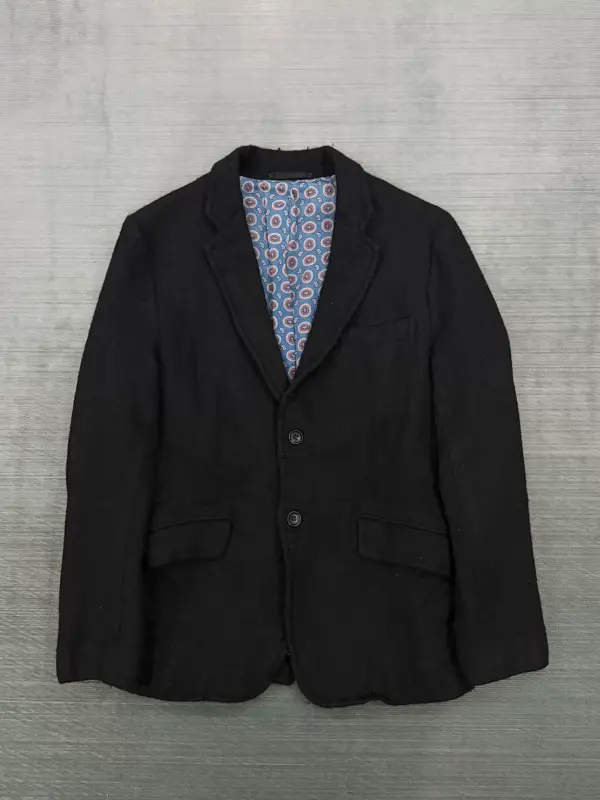
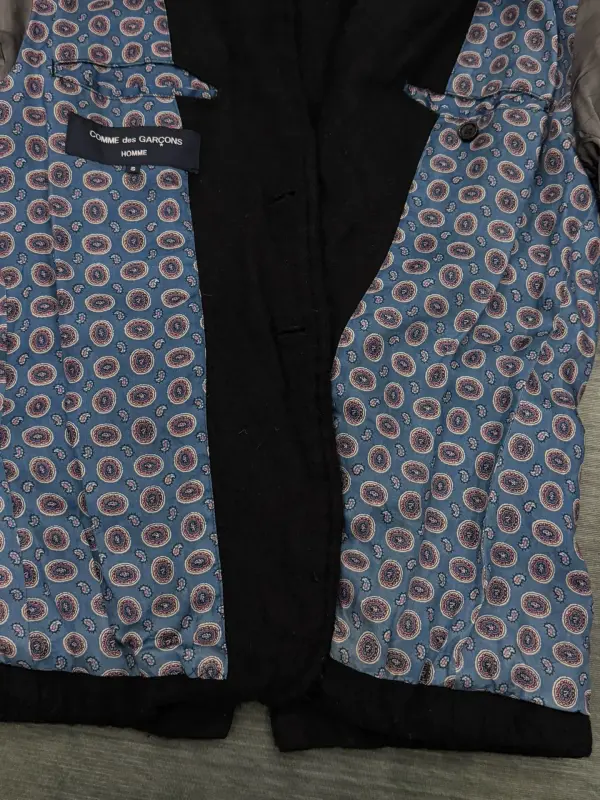
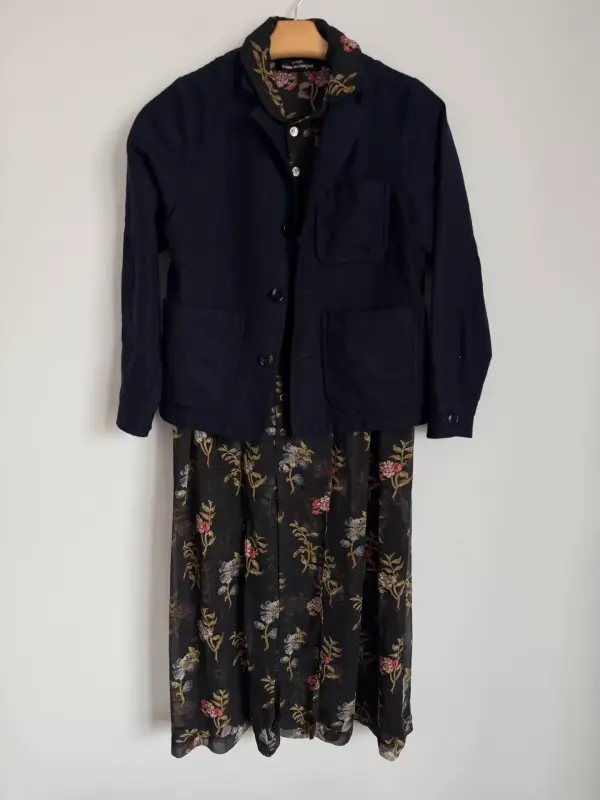
On the jacket below, the other side of the same tag repeats the code with the care instructions in English and French.
AD: the year it was made
AD2008 means the piece was made in 2008. That is the year of production, not the name of the collection, and the two are often mixed up in listings.
The spring/summer collection reaches the shops early in the year, so it is made the year before. One AD year therefore covers two seasons: autumn/winter of that year and spring/summer of the next. AD2008 is autumn/winter 2008 or spring/summer 2009. It is not spring/summer 2008.
AD is the year a piece was made, not the collection it belongs to.
The AD year has been on the label since autumn/winter 1988. Earlier pieces carry no year. They are dated by the look of the label and by matching the piece to collection photos.
The product code since autumn/winter 2001
A code from the last two decades looks like GE-B009. Each part has a job:
- The first character is the line. G is the main Comme des Garçons line, P is Homme Plus, H is Homme, D is Homme Deux, J is Junya Watanabe, R is Comme des Garçons Comme des Garçons, A is Play and 1 is Black. On the tricot pieces in our shop the code begins with T.
- The second letter is the season. The list is in the next section.
- The letter after the hyphen is the kind of garment. J is a jacket, C a coat, B a blouse, S a skirt, P pants, T a T-shirt, N knitwear, O a dress and V a vest.
- The numbers are the style number.
The season letters
The second letter moves on one step every season, from A to T, and then starts again at A. Twenty letters, two seasons a year: the alphabet comes round every ten years. The AD year tells you which round you are in.
- A: spring/summer 2008 and 2018. B: autumn/winter 2008 and 2018
- C: spring/summer 2009 and 2019. D: autumn/winter 2009 and 2019
- E: spring/summer 2010 and 2020. F: autumn/winter 2010 and 2020
- G: spring/summer 2011 and 2021. H: autumn/winter 2011 and 2021
- I: spring/summer 2012 and 2022. J: autumn/winter 2012 and 2022
- K: spring/summer 2013 and 2023. L: autumn/winter 2013 and 2023
- M: spring/summer 2004, 2014 and 2024. N: autumn/winter 2004, 2014 and 2024
- O: spring/summer 2005, 2015 and 2025. P: autumn/winter 2005, 2015 and 2025
- Q: spring/summer 2006, 2016 and 2026. R: autumn/winter 2006, 2016 and 2026
- S: spring/summer 2007 and 2017. T: autumn/winter 2007 and 2017
From autumn/winter 2001 to autumn/winter 2003 the letters ran less evenly, and two letters can share one season. For those years, lean on the AD year.
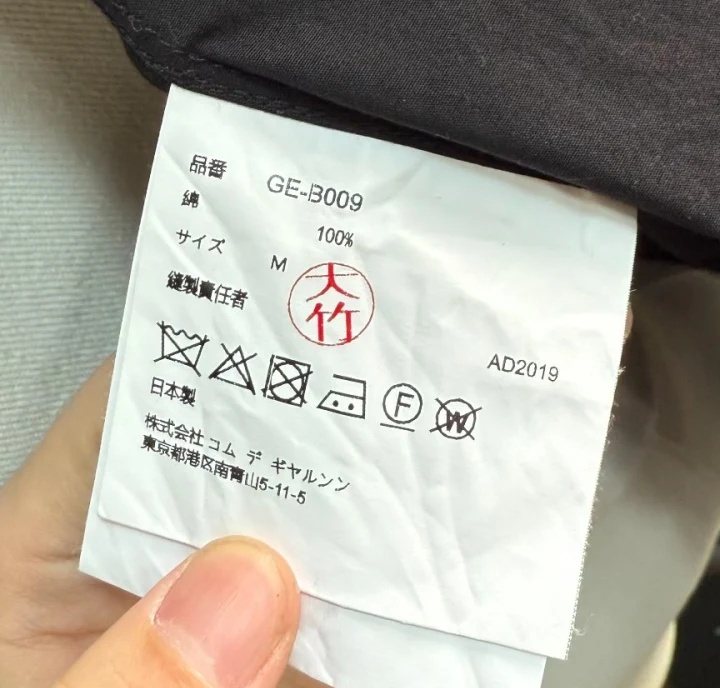
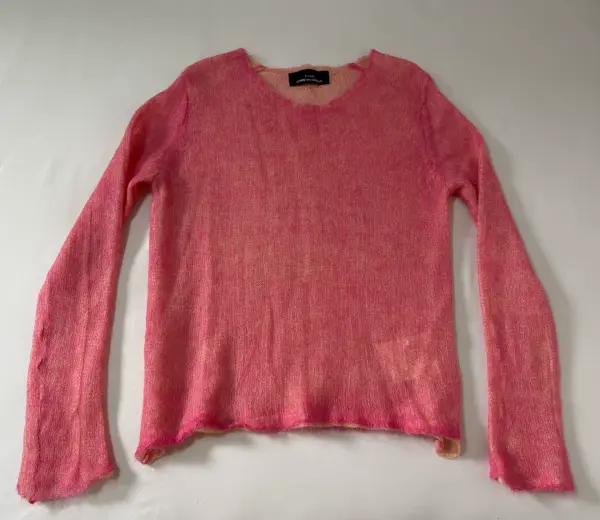
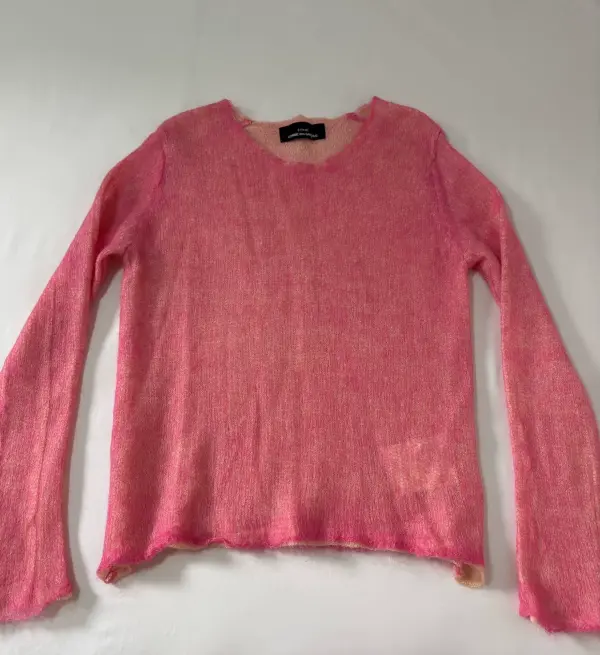
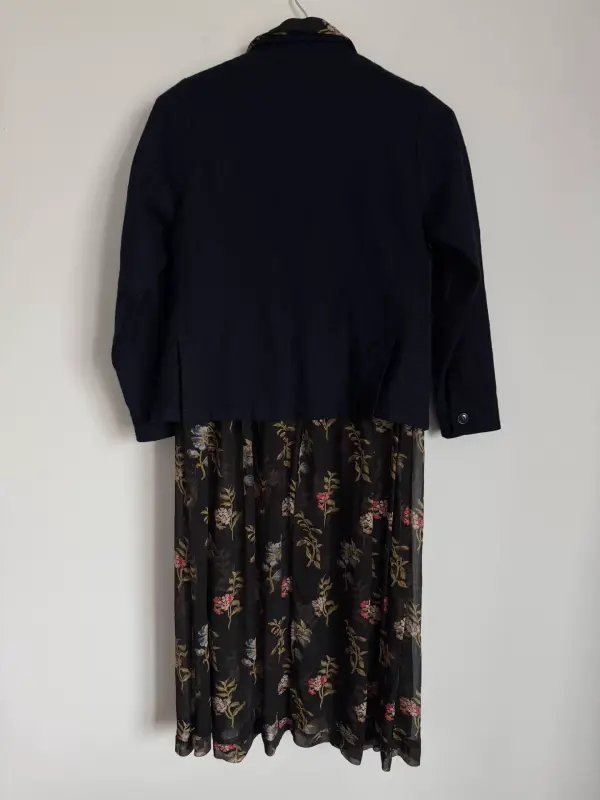
Two labels from pieces in our shop show how it works. The jacket further up reads 1C-J018 with AD2008: 1 is Black, C is spring/summer 2009 and J is a jacket. The top above reads GE-B009 with AD2019: G is the main line, E is spring/summer 2020 and B is a blouse. Both were made the year before their season, as spring/summer pieces are.
Older labels: 1988 to spring/summer 2001
Before the change in 2001 the code was built differently. It looks like RB-040190. The first letter is still the line and the second letter is the kind of garment. The season is the first digit after the hyphen: 0 is autumn/winter and 1 is spring/summer.
Put that digit together with the AD year. AD1999 with a 0 is autumn/winter 1999. AD1999 with a 1 is spring/summer 2000.
Spring/summer 2001 pieces generally still have the old code and autumn/winter 2001 pieces the new one, with some mixing in between.
Labels that do not follow the rule
- Play. The season letter is always Z, so the code does not give the season. The AD year narrows it to two.
- Shirt. Until 2020 the Shirt line used its own code: S for spring/summer or W for autumn/winter, then two digits. Take 8 from the digits to get the year, so W20 is autumn/winter 2012 and S25 is spring/summer 2017. From 2021 Shirt uses the same code as the other lines.
- Before 1988. There is no AD year. From the early 1980s the code already shows the season with a 0 or a 1, but the year has to come from collection photos.
What the label tells you
With a piece in your hands, read it in this order:
- The AD year gives the year it was made, and with it two possible seasons.
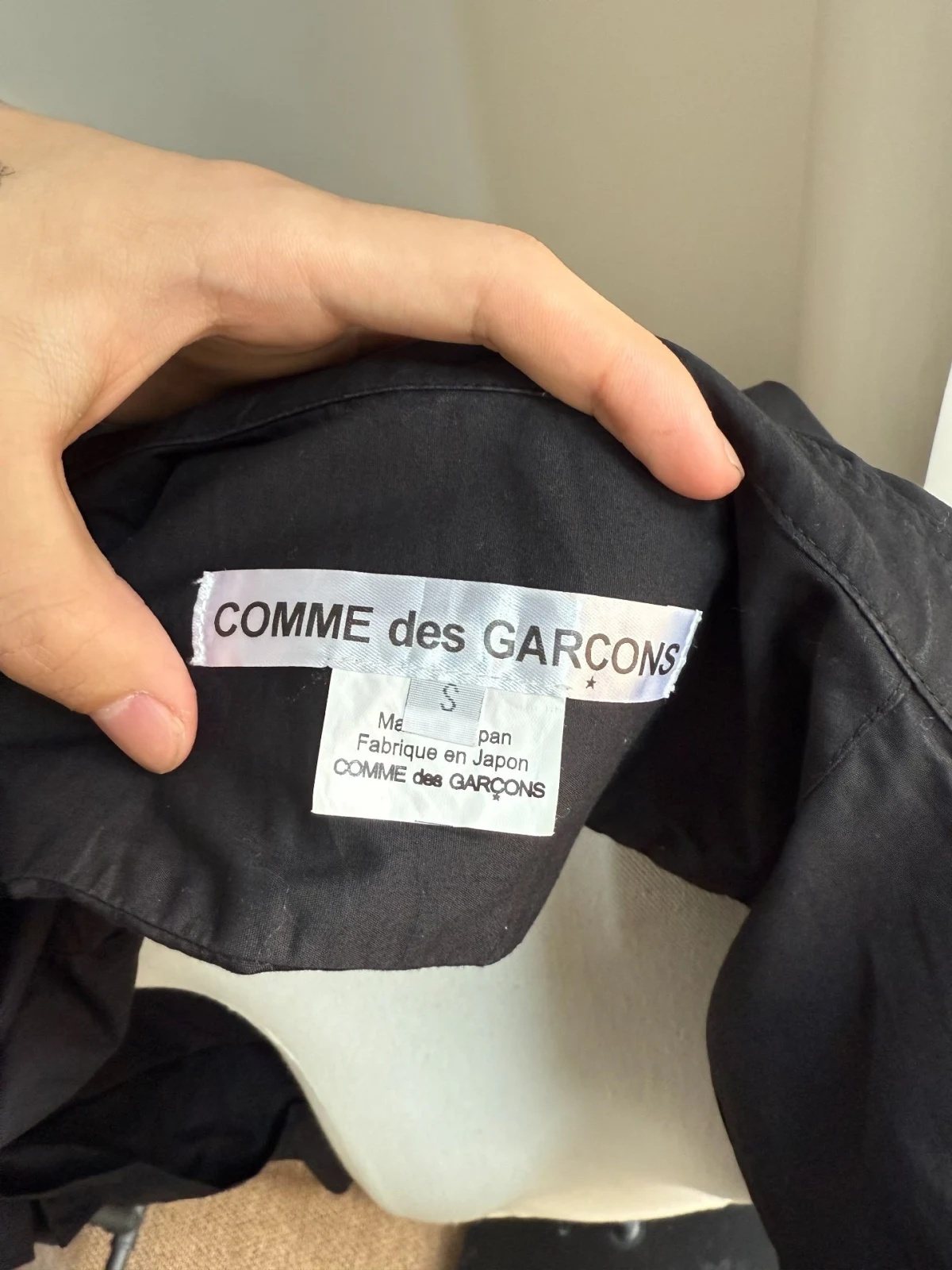
- The first character gives the line. It should agree with the brand label at the neck or waist.
- The season letter, or the 0 or 1 on older labels, picks one of the two seasons.
- The garment letter should match what you are holding. A code that says skirt on a jacket means the label is not the one the piece was made with.
A label can be copied, or moved from one garment to another, so a code that reads correctly is a good sign and not a proof. If you want us to read a label for you, send a photo in the chat.
Comme des Garçons in the shop now
Sources
Last updated 14 November 2026. Spotted a mistake? Tell us.
Keep reading
 Guide Junya Watanabe // 4 min read
Junya Watanabe: history, MAN vs women's and the label
Junya Watanabe explained: from Comme des Garçons pattern cutter to his own label, women's vs MAN, key collections, collaborations and how to read the label.
 Story Dior // 4 min read
Dior Homme jeans: Hedi Slimane's 21, 19 and 17 cm cuts
Dior Homme jeans by Hedi Slimane: what the 21, 19 and 17 cm cuts mean, the seasons from 2003 to 2007, who wore them and how to date a pair from the label.
 Story Number (N)ine // 4 min read
Number (N)ine and Kurt Cobain: the striped mohair sweater
How Kurt Cobain's £35 striped mohair jumper from a Belfast gig became Number (N)ine's AW03 Kurt Cobain sweater, and what Miyashita took from Nirvana.